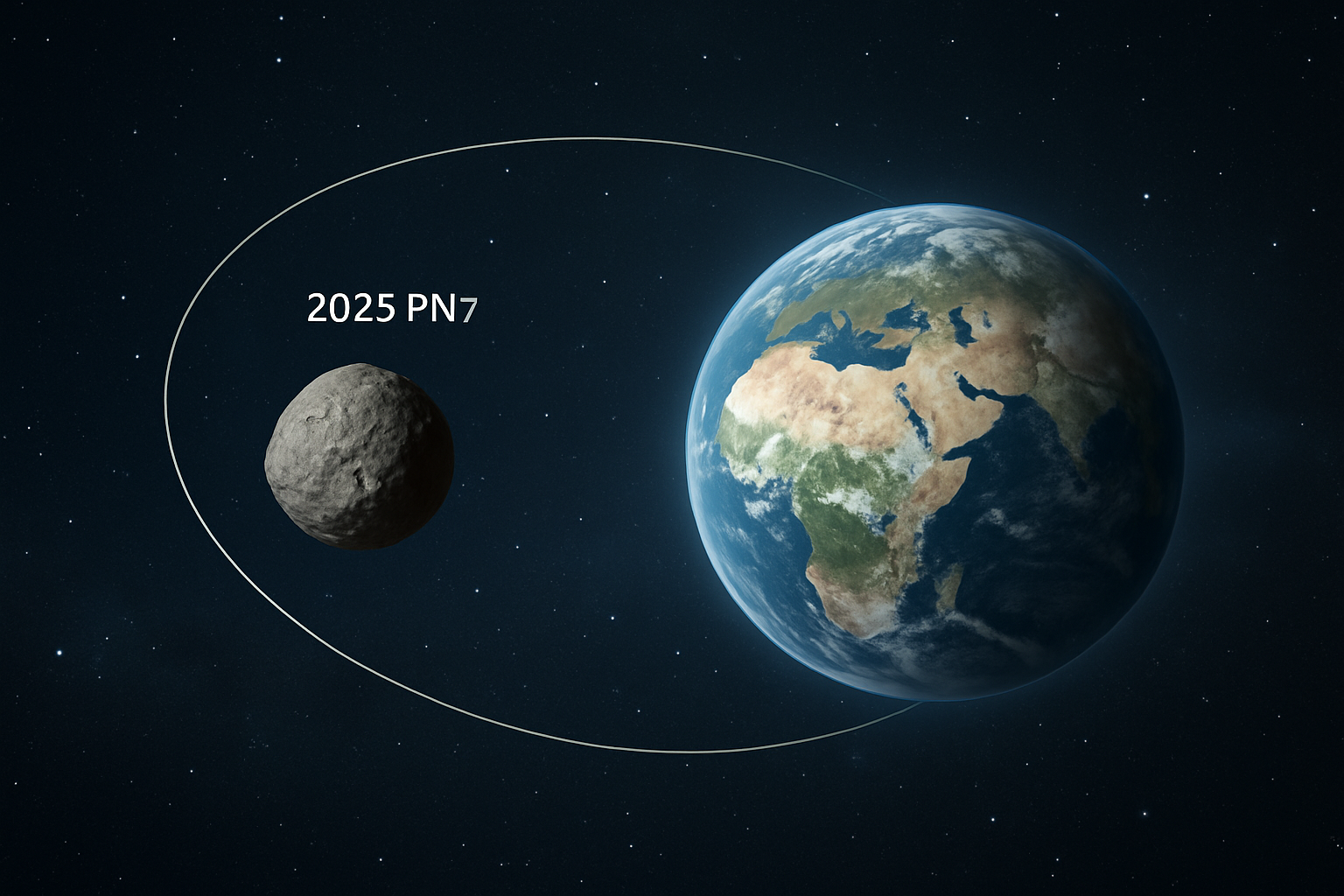
For the first time, astronomers have identified a small celestial companion that is effectively co-orbiting with Earth. Though it’s not a true moon in the familiar sense, the newly spotlighted rock is offering fresh insight into our planet’s cosmic neighborhood.
Discovery & Orbit
A tiny asteroid labelled 2025 PN7 was first observed on August 2, 2025 by the Pan‑STARRS telescope in Hawaiʻi.
Analysis suggests that though recently noticed, 2025 PN7 has likely been in a “quasi‐satellite” orbit with Earth for decades perhaps since the 1960s and will continue to share Earth’s spacetrack around the Sun for several more decades.
What Does “Quasi-Moon” Mean?
Unlike our bona fide moon, the Moon, which is gravitationally bound to Earth and orbits roughly every 27 days, 2025 PN7 is not firmly trapped by Earth’s gravity. Instead:
It shares Earth’s orbital path around the Sun in a 1:1 resonance meaning it takes about a year to orbit the Sun, just like Earth. Because of that shared pace, the asteroid appears to “hang around” Earth, making us say Earth has a “second moon” (though that phrasing is misleading). It never comes particularly close to Earth, so it poses no immediate danger to us.
Size & Impact
2025 PN7 is small estimates suggest it’s somewhere between 18 to 36 metres in diameter (roughly the size of a modest building). Because it’s faint and small, it was not spotted earlier.
Even though it shares Earth’s orbital space for now, its influence on Earth is negligible no effect on tides, gravity, or day-to-day life.
What’s Next?
- Scientists estimate this quasi-moon will remain in this dance with Earth until about 2083 roughly 60–70 more years.
- Its existence gives researchers a rare laboratory: a small body in Earth’s near-cosmic vicinity that can help us study how orbits evolve, how near-Earth asteroids behave, and potentially how material from the Moon or other bodies might get into Earth’s neighborhood.
- While it’s tempting to call it a “second moon”, experts caution that the term may mislead it’s not a proper satellite of Earth in the classic sense.