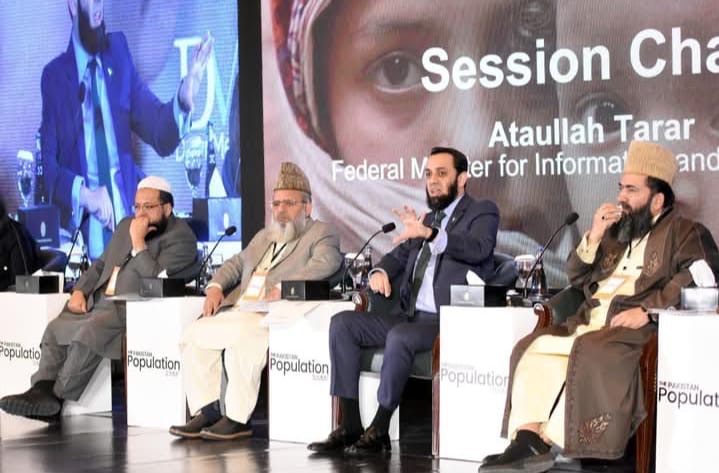
Minister for Information and Broadcasting Attaullah Tarar on Tuesday urged the adoption of a comprehensive and multi-pronged national strategy to tackle Pakistan’s rapidly growing population, warning that unchecked growth is exerting severe pressure on health systems and basic human rights.
Speaking at the Population Summit 2025, the minister emphasised the need for coordinated, cross-sector efforts and intensified public awareness campaigns. He said political leaders, religious scholars, and civil society must collaborate to steer the country toward sustainable solutions.
Tarar stressed that Ulema and parliamentarians should be actively involved in shaping the national population narrative, noting that religious leaders can play a decisive role in affirming that faith does not obstruct family planning or measures to manage population growth.
He highlighted the importance of family harmony and the protection of mothers, fathers, and children, proposing the creation of a joint working group focused on education and public awareness. He further urged summit organizers to issue a charter underscoring Parliament’s pivotal role in guiding the policy agenda. Inside the House, he added, lawmakers—particularly members of the women’s parliamentary caucus—could help drive meaningful debate and legislative action.
Addressing Pakistan’s dire health indicators, Tarar described the country’s high rate of maternal mortality as a form of “criminal negligence.” He noted that protecting mothers’ lives is a collective responsibility and warned that infant mortality, currently at 50 deaths per 1,000 live births according to UNICEF, must be urgently addressed to improve maternal health outcomes overall.
The minister also drew attention to neglected issues such as postpartum depression and maternal mental health, calling for wider recognition of their impact on both mothers and children. While acknowledging the economic constraints that limit public investment, he stressed that awareness and social responsibility remain crucial.
Pointing to Pakistan’s low female workforce participation relative to other regional countries, Tarar urged stronger efforts to empower women. He warned that population pressures exacerbate gender inequalities and undermine even the most fundamental human right the right to life by sidelining women’s health in a male-dominated society.
Tarar commended Dawn Media Group for hosting the summit, saying it provided an opportunity for the government to reflect on its shortcomings. Raising awareness, he said, is the shared duty of religious leaders, the state, health organizations, media, civil society, lawyers, and journalists.
He cautioned that Pakistan’s yearly population increase approximately equal to the entire population of New Zealand continues to be overshadowed by deteriorating health indicators. Without proportional investment in healthcare, he warned, unchecked population growth is costing the nation “countless young lives.”